

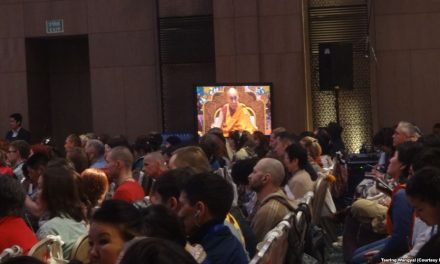
The Chinese authorities have tightened controls on Tibetans, in some areas going from house to house to confiscate people’s passports, in the buildup to a major religious ceremony to be held by the Dalai Lama in the pilgrimage town of Bodh Gaya, India.Some Tibetans who have already arrived in Nepal and India for pilgrimage and for attending the religious ceremony in Bodh Gaya have already been ordered to return, and their families pressured by the authorities. A Tibetan who spoke to several monks on pilgrimage in India from Tibet said that they were “very scared and anxious” after their families had received a warning from the authorities.
In the last few weeks, Government officials have confiscated passports in the Tibetan areas of Qinghai and Gansu, and according to some sources, also in Sichuan and the Tibet Autonomous Region. The restrictions are resonant of sweeping measures imposed during and after the 2012 Kalachakra taught by the Dalai Lama in Bodh Gaya, when hundreds of Tibetans returning to Tibet were detained and imprisoned for political ‘re-education’, with some disappearing for many months without families knowing where they were.
It is already extremely difficult for Tibetans to obtain passports, with very few Tibetans in the TAR and other areas being issued passports and others having theirs recalled – in contrast, more and more Chinese are travelling both abroad and freely in Tibet – but the new restrictions appear to be linked to preventing Tibetans from attending the upcoming Kalachakra ceremony in India. In Qinghai, according to the same sources, the government requires applicants for a Chinese passport to provide guarantees that they would not travel to India, where the Dalai Lama resides.
According to information received by ICT, passports have been restricted for Tibetans in Qinghai since September, and in Tibetan areas of Gansu since the middle of October. Tibetans in Sichuan and the TAR are also facing difficulties, with one Tibetan describing families in Qinghai as feeling “trapped and in despair” because they feared being unable to travel to pilgrimage sites in India and the teachings in Bodh Gaya. For older generation Tibetans, it is particularly distressing; many elder Tibetans have sought to see the Dalai Lama at least once in their lifetimes and teachings in exile represent an opportunity to do so.
A Tibetan in exile said: “Prefectural to county-level authorities in Qinghai and other areas are thoroughly checking the number of Tibetans who have a Chinese passport. Party cadres [often those based at village level] are confiscating passports of Tibetans who have them and warned those who are not at home and who have passports that they have to return by December 30, in order for new seals to be affixed. If not they are told that benefits such as ‘poverty alleviation’ funding and pensions will be cut. We can see clearly from the timing that this is targeted at preventing Tibetans from attending the Kalachakra, which begins on January 3 [2017].”
Tibetans on pilgrimage detained in Nepal
In a connected development, a group of 41 Tibetans who arrived in Nepal from eastern Tibet were detained this week and released yesterday (November 16). The group of Tibetans, including nuns and monks, was on pilgrimage from Tibet to sacred Buddhist sites in Nepal and India, most likely including Bodh Gaya, where the Buddha is believed to have been enlightened. The Dalai Lama will confer a Kalachakra (‘Wheel of Time’) initiation there from January 3-14 (2017).
Consistent with the tightening of controls on passports and Tibetan movements in Tibet, the Chinese authorities are likely to have stepped up pressure on the Nepalese authorities to comply in targeting Tibetans in transit through Nepal, including those with legitimate Chinese passports.
The Chinese official Global Times issued a statement on the arrests of the Tibetans, who were stopped on Monday (November 14) southwest of Kathmandu while travelling by bus to India. The article, which appeared to be intended to convey a warning to other Tibetans who may have been intending to travel to Nepal or India, cited a Nepalese immigration official saying that the Tibetans would be “handed over to the United Nations High Commissioner for Refugees” if they were found to be “genuine refugees”, or “Otherwise they may be deported back to the country they came from.” (Global Times, November 17, 2016). The Global Times also noted that there were tougher border controls between China and Nepal than before, although it attributed the decline in Tibetan refugees via Nepal since 2008 to increasing prosperity in Tibet.
In recent years the Chinese authorities have imposed sweeping new measures in order to prevent Tibetans travelling to teachings by the Dalai Lama outside Tibet, and to punish those who do. For the first time at a major Buddhist teaching by the Dalai Lama in 2014, the Kalachakra in Ladakh, there were more Chinese Buddhists present than Tibetans from inside Tibet. The restrictions threaten the survival of Tibetan Buddhist teachings in Tibet by making it nearly impossible for monks and nuns who wish to travel outside the PRC to receive instruction from teachers who are in exile, and difficult for exiled teachers to get permission to travel within Tibet to give teachings.
From 2012, following the imposition of tough new measures restricting travel in Tibetan areas since the 2008 protests, Tibetans began to face tightening restrictions on the issuance of passports, limiting their travel outside Tibet – for instance to teachings of the Dalai Lama, or to study abroad. This is in contrast to the increasing number of Chinese citizens being granted a passport, and the dramatic increase in domestic tourism to Tibet, with Tibet being branded as a spiritual, romantic destination.
An earlier ICT report detailed how the Chinese authorities used the opportunity of a PRC-wide transition to electronic passports in 2012, when Chinese nationals were required to submit outdated passports for replacement, to single out both Tibetans and Uighurs for more severe restrictions and punitive measures. Regulations issued in 2012 in the Tibet Autonomous Region required all Tibetans in the Tibetan region to surrender their old passports, even when their validity had not expired, ostensibly to be replaced by the electronic version. But in numerous cases, the passports were not replaced.
The issue has been hotly developed on social media sites in the PRC, with many netizens challenging the discriminatory policies against Tibetans. One posting on the website of the Qinghai Provincial Bureau of Petitions challenged officials to answer the question of “whether it is the rules of the provincial government or the rules of the Public Security Bureau that Qinghai’s minority nationalities cannot apply for a passport, [given that] the Passport Law provides that applying for a passport is the right of every citizen under the Chapter 1, Article 4 of the Constitution of the People’s Republic of China.” The official response stated: “Regarding the problem of the masses’ hope that our province will open up the passport-on-demand policy for ordinary passports as soon as possible, we shall continue to work in accordance with the requirements of the provincial committee, provincial government and the Public Security Bureau and coordinate with the corresponding work units to actively promote this work.” The official answer also said that the netizen’s application for a passport had been rejected “following an investigation by the Entry and Exit Administration of the Public Security Bureau”.





Recent Comments